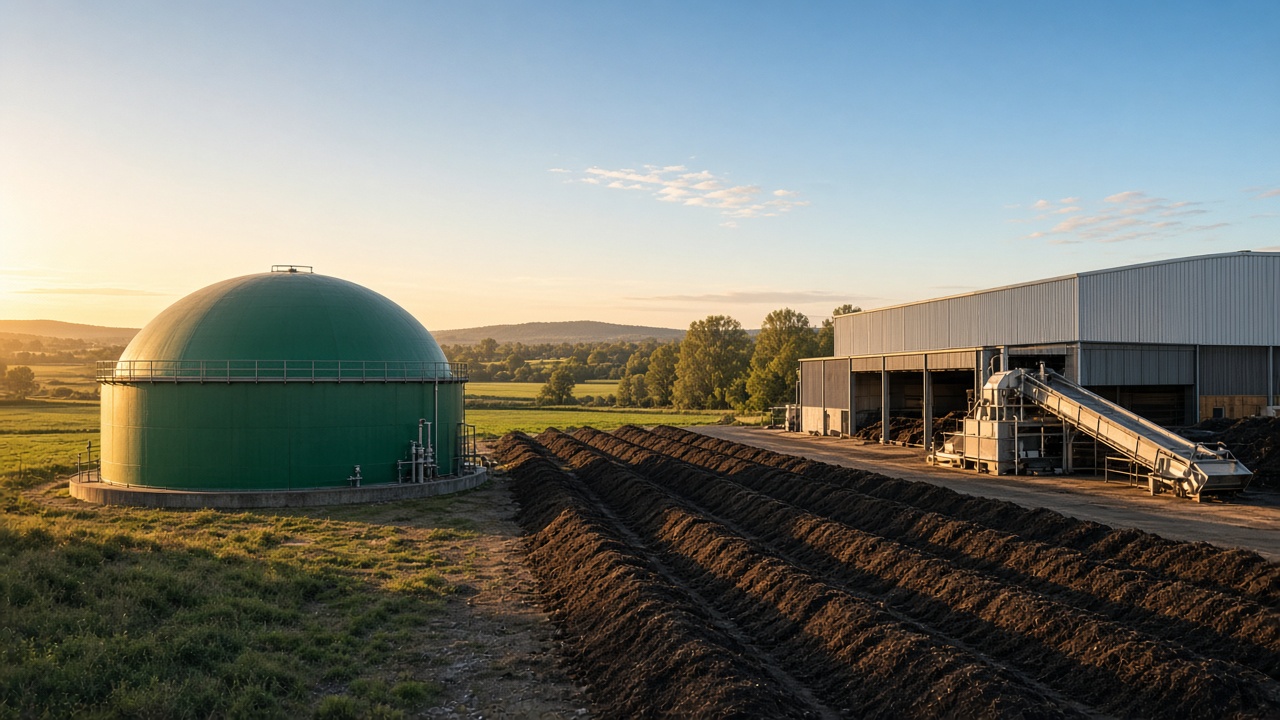
Biogas is the right choice for sites with a large, continuous organic waste stream that can use the energy. For a few hundred kilograms to a few tonnes a day, an in-vessel compost system is simpler, faster to start and modular.
Whether biogas or compost is better depends on your waste volume and your goal. Biogas makes sense where there is a large, continuous waste stream, gas infrastructure and a use for the energy. Composting is an aerobic, simpler and modular process that starts quickly and produces a soil improver. For most businesses and mid-sized municipalities, composting is the better fit.
Hotel groups, food manufacturers and municipalities planning an organic waste investment all face the same question: should the waste become energy or soil? Both methods keep organic waste out of landfill and cut methane emissions, yet they differ sharply in investment, operation and output. Here we compare both processes in plain language and show when each one makes sense. To estimate your own volumes first, see our guide to compost machine capacity selection.
What Is the Difference Between Biogas and Compost
Biogas (anaerobic digestion) is the breakdown of organic waste by microorganisms in a sealed reactor without oxygen. It produces a gas containing roughly 50–70 % methane by volume and a wet residue called digestate. The gas is burned in a boiler or a combined heat and power (CHP) unit to generate electricity and heat.
Composting is aerobic, meaning it needs oxygen. Microorganisms convert the waste into carbon dioxide, water vapour and heat; the material reaches a thermophilic phase of 55–65 °C and ends up as compost used as a soil improver. When oxygen is kept above 5 %, methane formation is minimal.
The chart shows an important fact: organic waste sent to landfill still produces methane, but much of that gas escapes uncontrolled. Over 100 years, methane warms the climate about 27–30 times more than CO2 (IPCC AR6). A biogas plant produces and captures methane on purpose, while composting prevents it from forming in the first place.
Biogas vs Compost Comparison Table
The table below puts the questions we hear most often side by side. Values are typical ranges; exact figures depend on the composition of your waste.
| Criterion | Biogas | Compost (in-vessel machine) |
|---|---|---|
| Oxygen | None (anaerobic) | Continuous aeration (aerobic) |
| Temperature | Usually 35–40 °C or 50–55 °C | Thermophilic phase 55–65 °C |
| Duration | Weeks in the reactor | 24–48 hours in the machine + a few weeks of curing |
| Main output | Biogas (energy) + digestate | Pre-compost / compost (soil improver) |
| Suitable scale | Large, continuous volumes | From 25 kg/day to tens of tonnes, modular |
| Investment complexity | High: reactor, gas storage, CHP, safety, permits | Moderate: machine, feeding, curing area |
| Operation | Steady feeding, specialist team, gas safety | Daily routine with a trained operator |
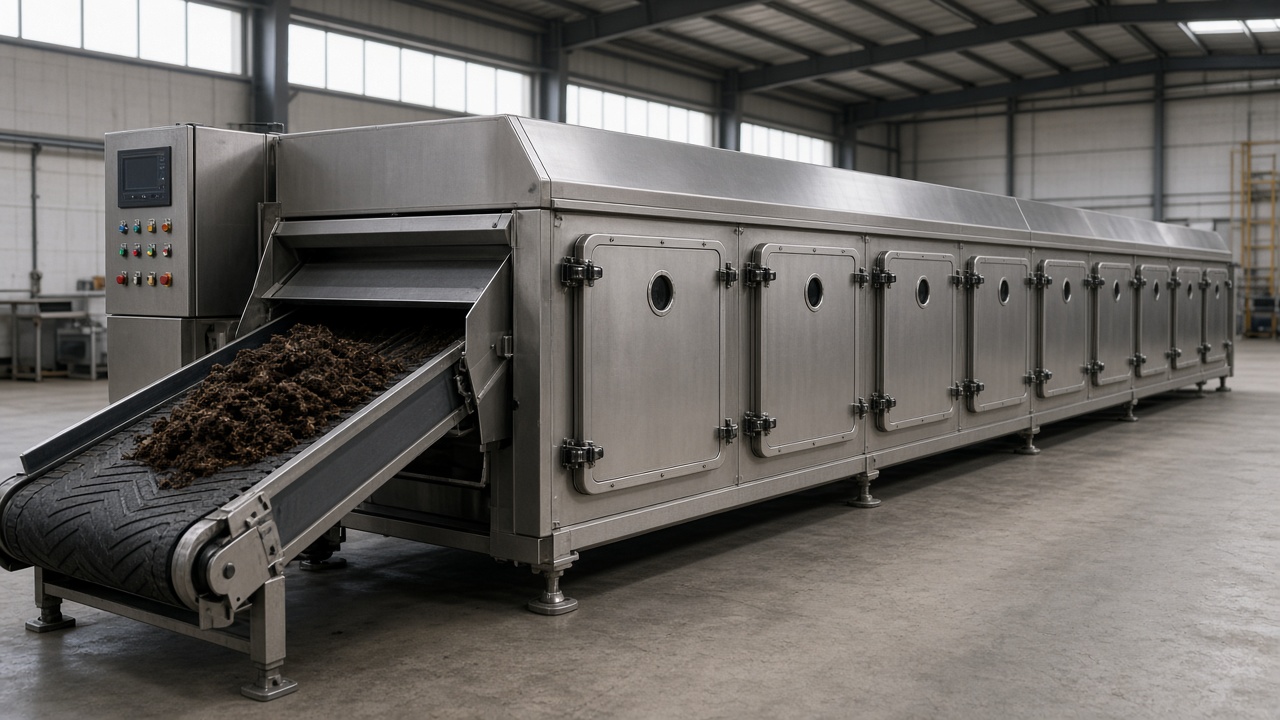
The decisive row is scale. With high fixed costs, biogas only pays off at large volumes, while a compost machine works at its own scale in a small business or a district municipality.
When Is Biogas the Right Choice
It would be wrong to underrate biogas; under the right conditions it is a very strong technology. It deserves serious consideration when:
- the waste arrives in large volumes, continuously all year (metropolitan scale, large food industry, livestock regions);
- the waste is very wet, close to liquid and pumpable;
- you can use the electricity and heat on site or sell them;
- a long-term operating team and investment capacity are in place.
Some facts are often overlooked. Digestion is sensitive to feeding fluctuations; seasonal changes can lower gas yield. Gas storage and flaring equipment require explosion safety measures, permits and continuous supervision.
Warning: Biogas does not make the waste disappear. The remaining digestate usually needs dewatering followed by further treatment such as composting. Make sure your feasibility study includes this cost.
We explain how capacity is calculated at municipal scale in our article on choosing capacity for a municipal organic waste plant.
When Is Composting the Better Option
For hotels, hospitals, campuses, food factories and district municipalities, composting is usually the more realistic route. In our site surveys we usually see the same picture: waste volumes change with the season, space is limited and the team is not set up to run an energy plant. This is where an in-vessel compost machine stands out.
- Modular growth: start with today's volume and add a second unit as it grows.
- Fast commissioning: no gas line or grid connection needed.
- Usable product: the output serves as a soil improver in parks, landscaping and agriculture.
- Controlled odour: a closed, aerated system reduces odour and hygiene risks.
You can read how odour is managed in closed systems in our article on controlling odour in organic waste, and the cost side in our guide to compost machine return on investment. Haulage and landfill savings usually dominate the payback.
Tip: The two methods do not have to compete. At large sites biogas and composting can work together, with digestate and structural waste processed on the compost line.
How to Decide Between Biogas and Compost
A good decision starts with data, not with a technology preference. Quoting a fixed tonnage threshold would be misleading; as a rule, biogas only makes sense with large and continuous volumes, and a feasibility study gives the definitive answer. We recommend this sequence:
- Measure the waste Weigh it for at least 7–14 days and record seasonal peaks and composition.
- Clarify the goal Is your priority energy production, on-site treatment and zero waste, or a soil improver?
- Identify who takes the output Who will use the energy, where will the compost go and how will digestate be treated?
- Commission a feasibility study Compare investment, operating costs, permits and staffing for both scenarios.
- Start scalable If there is uncertainty, begin with a modular compost line and update the data as you grow.
You can see an initial capacity estimate in a few minutes with our online capacity selector. For a fuller comparison, our consulting service covers waste analysis, process design and feasibility together.
Putting It into Practice with ReBorn Cycle Compost Machines
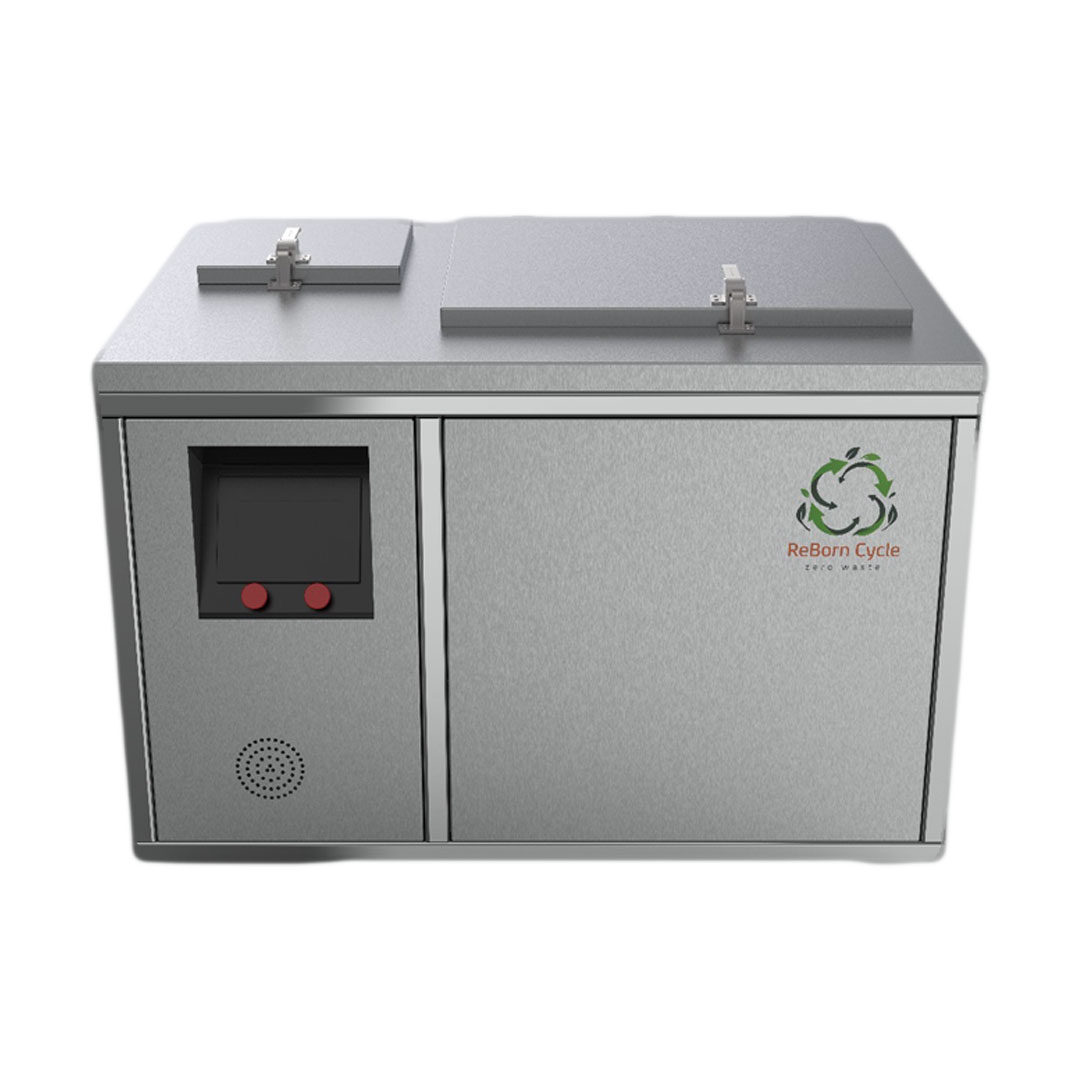
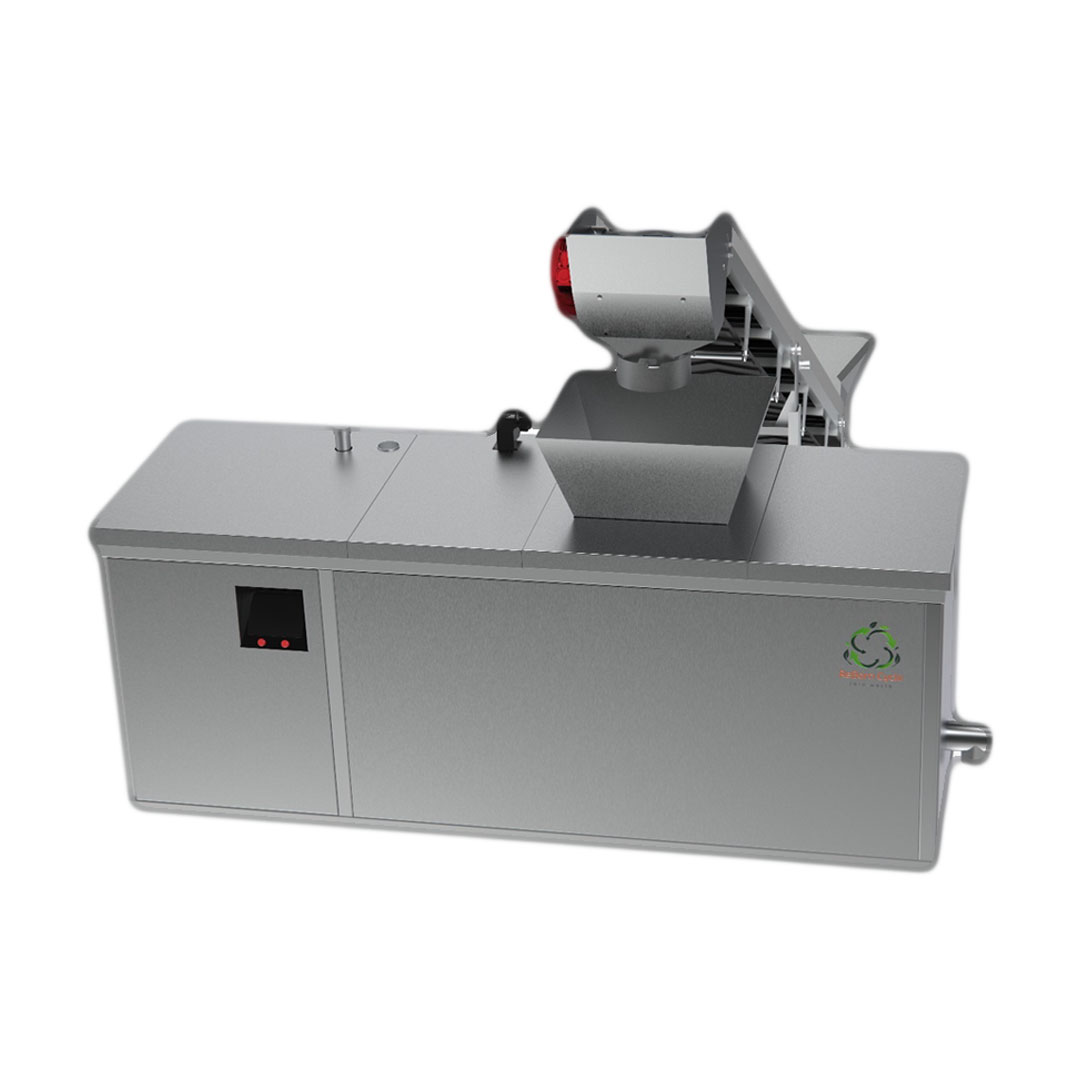
ReBorn Cycle machines are closed, heated, aerated and mixed in-vessel systems. Because temperature, aeration and mixing are controlled, kitchen waste with balanced moisture typically becomes a stabilized, hygienized pre-compost in 24–48 hours. With fatty or irregular feeding this can take 48–72 hours. For fully mature compost we recommend a curing period of a few weeks.
Typical choices by scale are RBN-C500 Compost Machine (500 kg/day) for central kitchens and corporate sites, RBN-C1000 Compost Machine (1,000 kg/day) for large hotels and industrial plants, and RBN-C2500 Compost Machine (2,500 kg/day) for municipalities and food production. For larger volumes, several units run side by side.
The process starts with a site survey; installation, commissioning, operator training and after-sales service are handled by our in-house team. With municipalities and investors planning a biogas plant, we also assess hybrid scenarios together through a project partnership.
Frequently asked questions
How much waste do you need for a biogas plant?
There is no single universal threshold; the required volume depends on waste type, energy prices and the investment model. The general rule is that biogas is only economical with large volumes that arrive continuously all year. If your waste fluctuates with the season or stays below a few tonnes a day, commission an independent feasibility study before deciding.
Can digestate from a biogas plant be used directly as fertiliser?
Not always. Digestate contains nutrients, but it is usually very wet and not fully stable. Many plants first dewater the digestate and then compost it to turn it into a product that is safe in terms of odour and hygiene. Check the current regulations and product criteria in your country before using it.
Does composting produce methane?
In a well-managed composting process methane formation is very low, because the process is aerobic. Methane appears in compacted, overly wet zones where oxygen drops below 5 %. In in-vessel compost machines, continuous aeration and mixing prevent these zones from forming; open piles need regular turning instead.
Can biogas and composting be used together?
Yes, this is a common model at large sites. Wet, pumpable waste goes to the biogas reactor, while digestate and structural waste such as branches and leaves are processed on the compost line. The result is both energy and a soil improver. This set-up only makes sense if volumes are large enough to feed both lines.
Is biogas or compost better for municipalities?
For most district and mid-sized municipalities, composting can be implemented faster and with lower risk. At metropolitan scale, with established separate collection and a continuous waste stream, biogas can also be considered. A practical path is to start separate collection in a pilot district and gather real data with a modular compost plant.
Choosing the Right Technology for Organic Waste
Biogas and composting are two valuable ways to divert organic waste from landfill. Biogas produces energy at large, continuous volumes but demands high investment, specialist operation and digestate management. Composting is simpler, modular and quick to commission, and its output goes straight back to the soil.
Our recommendation is to decide based on measurement, not estimates. Once two weeks of weighing data, seasonal variation and the end use of the output are clear, the right technology usually becomes obvious. If uncertainty remains, starting with a modular compost line keeps the door open both to growth and to a later move to biogas.
If you would like to work out together which route makes sense for your waste, you can book a free site survey. Our team will review the quantity and composition of your waste on site, compare both scenarios with clear figures and recommend the right capacity. If biogas turns out to be the better choice for you, we will tell you that openly.