Yes. Diverting organic waste from landfill to controlled aerobic composting largely prevents methane formation, and on-site treatment also cuts emissions from waste transport.
Yes, composting reduces carbon emissions. When organic waste decomposes without oxygen in a landfill, it produces methane, a potent greenhouse gas; in controlled aerobic composting, the carbon is released mostly as biogenic CO2. According to IPCC AR6, the 100-year global warming potential of biogenic methane is 27.0. On-site treatment also lowers transport emissions.
Sustainability teams at hotels, food plants and municipalities keep asking whether composting really affects their carbon footprint and how to prove it. According to FAO, roughly one third of all food produced is lost or wasted, so where that waste ends up matters for the climate. This article explains landfill methane, why aerobic composting is different, the emission logic behind options for managing food waste and how to calculate the reduction without made-up numbers.
How Does Composting Reduce Carbon Emissions?
The climate benefit of composting is measured against where the organic waste would otherwise go. In Turkey and worldwide, a large share of organic waste that is not collected separately still ends up in landfills. There, oxygen in compacted waste layers runs out quickly and decomposition becomes anaerobic, which produces methane.
In controlled composting, microorganisms work with oxygen. Part of the carbon in organic matter returns to the atmosphere as biogenic CO2, and part stays in the compost as stable organic matter. Biogenic CO2 is carbon that plants recently took from the atmosphere, which is why greenhouse gas inventories treat it separately from fossil CO2.
The reduction comes from three sources:
- Avoided methane: Waste that never reaches the landfill cannot generate methane there.
- Avoided transport: On-site treatment reduces truck trips and fuel use.
- Return to soil: Compost adds organic matter to soil and can replace other inputs in some uses.
In the US EPA Food Recovery Hierarchy, composting also ranks above landfill and incineration, although the top tier is not generating the waste in the first place.
Why Does Organic Waste Produce Methane in Landfills?
According to the US EPA, landfill gas is roughly 50% methane and 50% carbon dioxide, produced mainly by the anaerobic breakdown of organic waste. Because food scraps decompose quickly, they contribute early and heavily to landfill methane. Even at sites with gas collection systems, not all of the gas is captured.
The impact of methane is converted into CO2 equivalent using its global warming potential (GWP). According to IPCC AR6, over a 100-year horizon the GWP of biogenic methane is 27.0 and that of fossil methane is 29.8. In other words, one metric ton of biogenic methane has about the same warming effect as 27 metric tons of CO2.
Methane from organic waste is biogenic, so waste calculations usually use the value of 27.0. Choose the value according to the requirements of your reporting framework.
How Do Aerobic and Anaerobic Decomposition Differ in Emissions?
Not every kind of composting is equally low in emissions. Poorly managed open piles can develop oxygen-free pockets and release small amounts of methane and nitrous oxide (N2O). What matters is how consistently the process is kept aerobic. For details, see our article on the difference between aerobic and anaerobic composting.
| Route | Main emission source | Note |
|---|---|---|
| Landfill | Methane from anaerobic decomposition | Partly captured if gas collection exists |
| Unmanaged open pile | Methane and N2O from oxygen-free pockets | Risk of odor and leachate |
| Closed, controlled aerobic composting | Mostly biogenic CO2, energy use | Aeration and mixing minimize methane |
| Prevention and donation | No waste is generated | Top tier of the hierarchy |
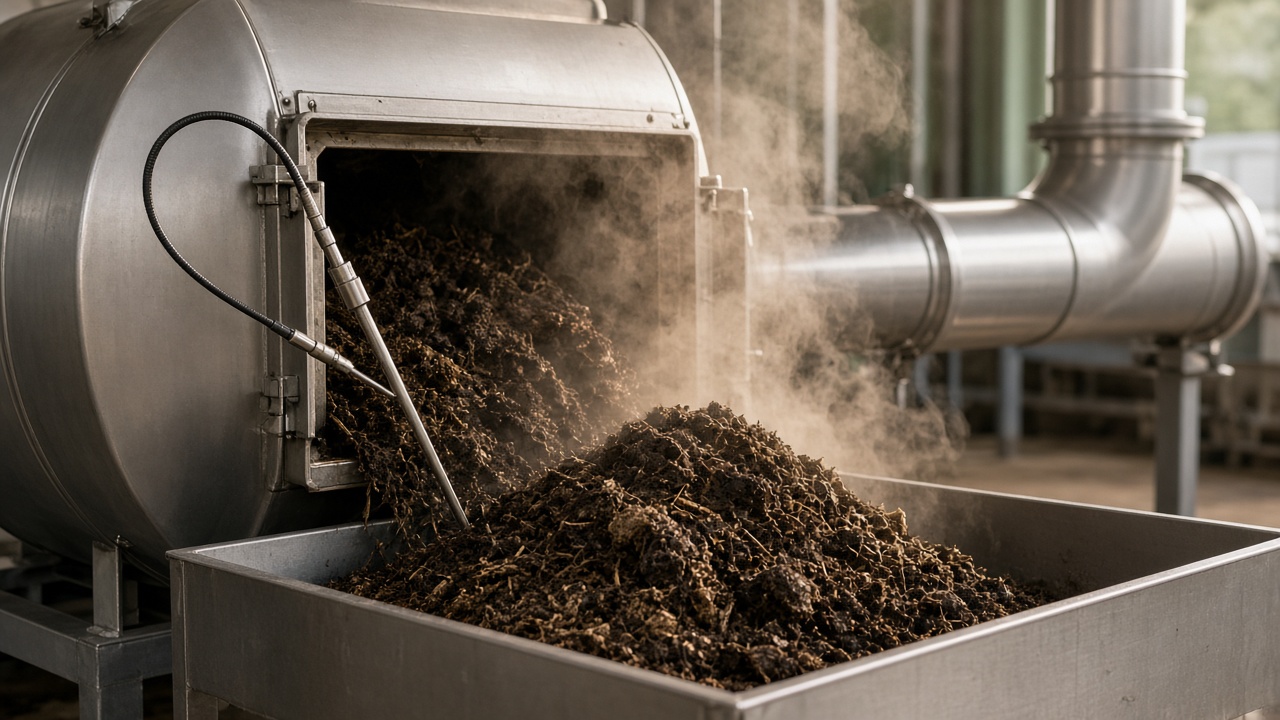
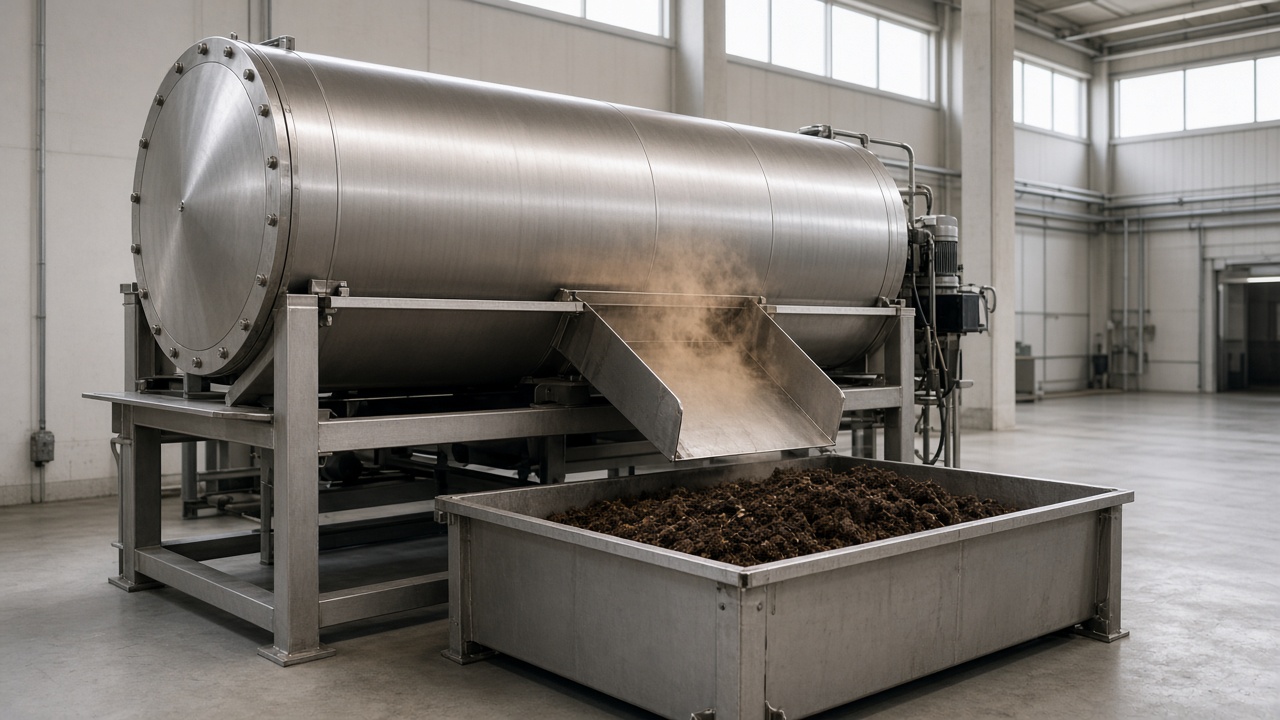
Closed systems continuously control temperature, moisture and oxygen. While the thermophilic phase is held at 55–65 °C, adequate aeration keeps oxygen above 5%, which limits the formation of anaerobic zones.
How Do You Calculate the Carbon Reduction from Composting?
A credible calculation relies on recognized emission factors and measured data, not invented coefficients. The logic is a comparison between a baseline scenario and a project scenario.
- Measure the waste quantity Determine annual organic waste in metric tons from weighing records.
- Define the baseline Where would the waste go without composting? Identify the landfill, whether it collects gas and the transport distance.
- Calculate baseline emissions Multiply the quantity by a landfill emission factor from the national inventory or IPCC guidelines.
- Calculate project emissions Add a recognized factor for the composting process, the machine's electricity use (kWh × grid factor) and any remaining transport.
- Add the transport difference Fewer trips × distance × vehicle emission factor.
- Report the net reduction Baseline minus project emissions; document every assumption and source.
The GWP conversion itself is simple: 2 metric tons of biogenic methane × 27.0 = 54 metric tons of CO2e. The real uncertainty lies in the emission factors that estimate how much methane would form.
Warning: Do not use a single "savings per ton" figure found online. Factors vary with waste composition, landfill gas capture and country, and a coefficient without a traceable source will be rejected in an audit.
How Is Composting Shown in Scope 3 Reporting?
Under the GHG Protocol approach, emissions from waste generated on site and treated elsewhere are reported under Scope 3, Category 5 (waste generated in operations). When you compost organic waste on site instead of sending it to landfill, this item shrinks.
On the other hand, the emissions of on-site treatment enter your inventory: the machine's electricity use falls under Scope 2, while any small amounts of methane and N2O from the process occur at your own facility and fall under Scope 1. In most frameworks, biogenic CO2 is reported separately, outside the scopes.
- Keep weighing records for waste quantities.
- Meter electricity use instead of relying on estimates.
- Present avoided emissions as a separate indicator rather than deducting them from the inventory.
We show with examples how to reflect this data in a report in our article on organic waste in hotel ESG reports. Your reporting framework (GRI, CDP, etc.) may require different detail, so check its current guidance.
How Do ReBorn Cycle Machines Help Reduce Emissions?
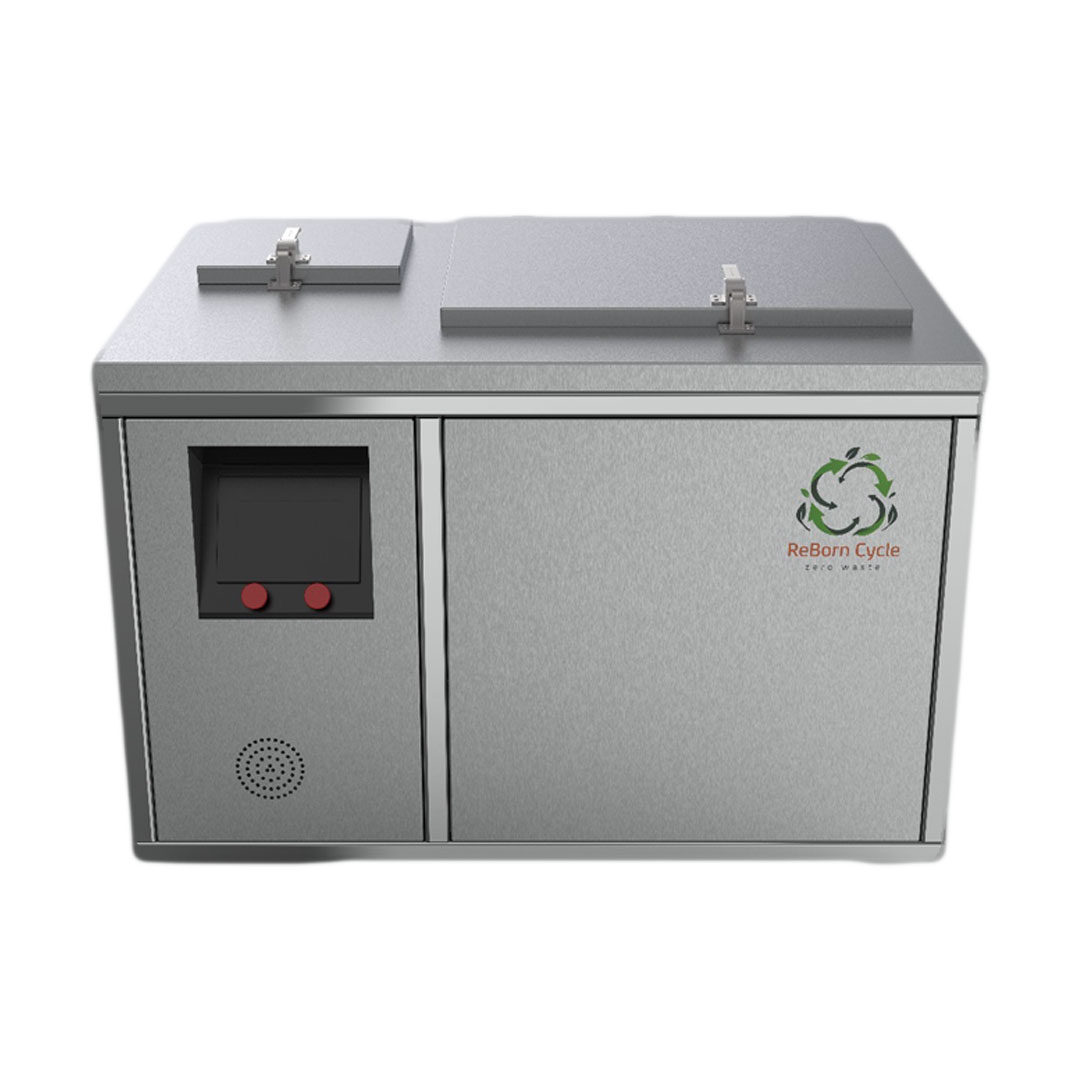
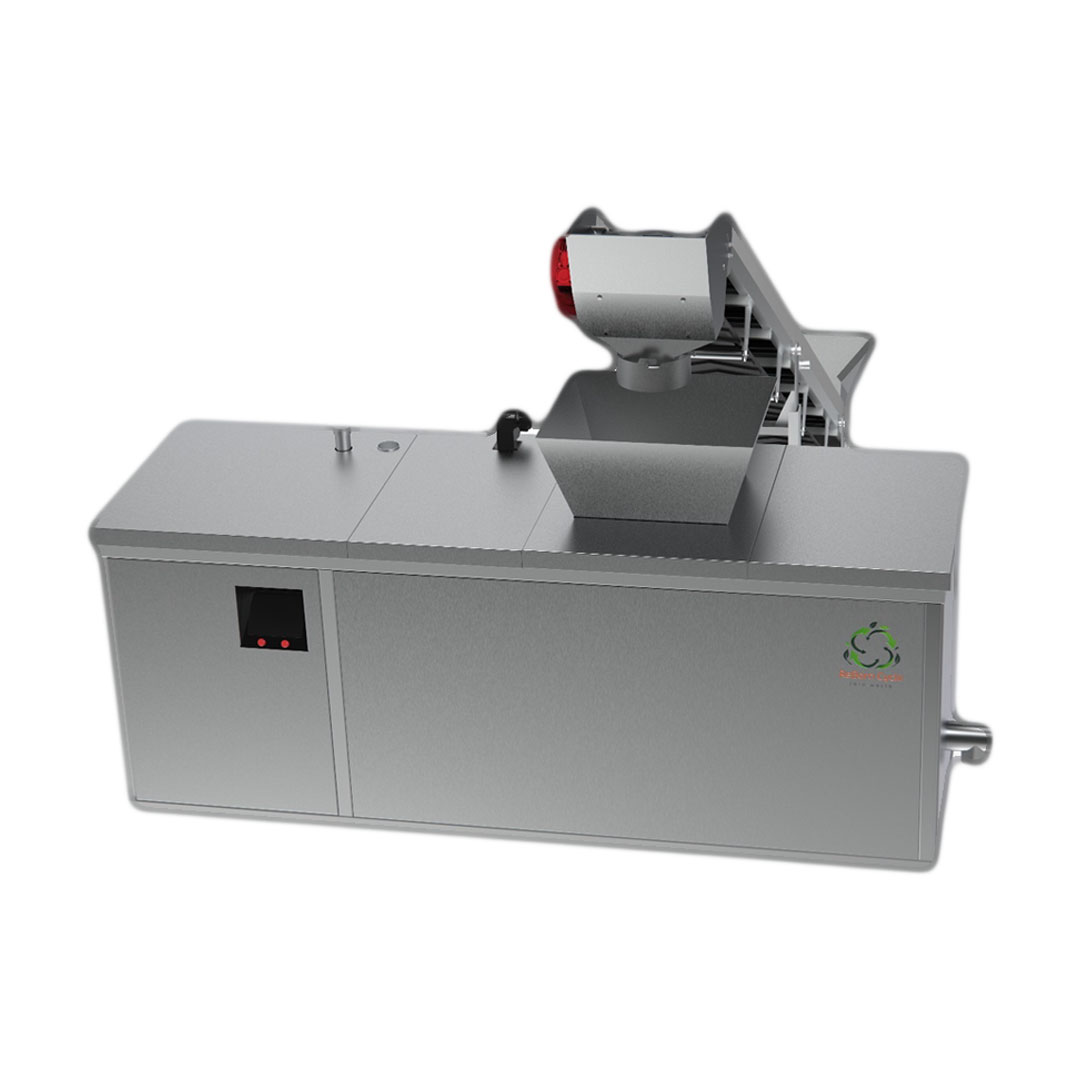
ReBorn Cycle compost machines are closed in-vessel systems with controlled temperature, aeration and mixing. This design helps keep the process aerobic and reduces the risk of the oxygen-free pockets found in open piles. For kitchen waste with balanced moisture, the in-machine cycle is typically 24–48 hours.
Example capacities for high-volume sites:
- RBN-C500 Compost Machine – 500 kg/day, for central kitchens, municipalities and corporate campuses
- RBN-C1000 Compost Machine – 1,000 kg/day, for large hospitality and industrial sites
Because volume can be reduced by up to about 80–90% depending on the input, the amount hauled off site and the number of trips drop significantly. We cover the cost side in our article on organic waste logistics costs. The machine's electricity use must also be included in the carbon calculation; see our guide to compost machine power consumption.
Tip: Collect a few weeks of weighing and trip data before installation; the stronger your baseline, the more credible the reported reduction.
Frequently asked questions
Does composting produce no greenhouse gases at all?
It does produce some, but with far less impact. In composting, carbon is released mostly as biogenic CO2; poorly managed piles may also emit small amounts of methane and N2O. Closed systems with aeration and mixing minimize this risk. The machine's electricity use should also be included in the calculation.
What is the global warming potential of methane?
According to IPCC AR6, over a 100-year horizon the global warming potential of methane is 27.0 for biogenic methane and 29.8 for fossil methane. This means one metric ton of methane has roughly the same warming effect as 27–30 metric tons of CO2. Organic waste calculations usually use the biogenic value.
How many tons of CO2e does composting one ton of organic waste save?
There is no single correct figure; the result depends on waste composition, gas capture at the baseline landfill, transport distance and the emission factor of the power grid. Calculate it using your own measured data together with factors from recognized sources such as the national inventory or IPCC guidelines.
Which scope does composting affect, Scope 1, 2 or 3?
Waste treated off site is reported under Scope 3, Category 5, and on-site composting reduces that item. The machine's electricity use goes into Scope 2, and any small amounts of methane and N2O from the process at your facility go into Scope 1. Biogenic CO2 is usually reported separately, outside the scopes.
Does landfill gas collection reduce the benefit of composting?
Yes, partly, because some of the captured methane is flared or used for energy. However, gas collection systems cannot capture all of the gas, and since food scraps decompose quickly, part of the methane can form before the system is in place. State site-specific assumptions clearly in your calculation.
Does prevention or composting reduce more emissions?
Prevention is always more effective; waste that is never generated has no production, transport or disposal emissions. The US EPA Food Recovery Hierarchy also recommends source reduction first, followed by food donation and animal feed. Composting is a much better option than landfill for organic waste that cannot be avoided.
To determine the right capacity for your organic waste volume and a measurable carbon reduction plan, request a site survey and capacity recommendation.